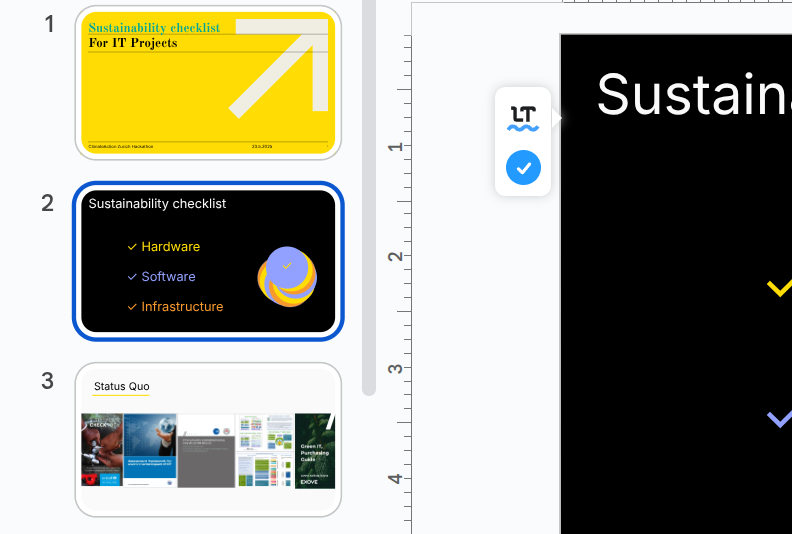
 We've started working on the slides, and have some initial content for communicating the idea. In the last couple of hours hope to have a workflow demo.
1 year ago
~
Oleg
- Appointing someone within IT to track progress. This person should create the GreenIT strategy specifically applied to the company.
- Measure the environmental impact of IT, with a proper tool
- Extending the lifetime of equipment in general (PCs, smartphones, servers, screens…)
- Responsible purchasing (Prioritize purchasing reconditioned equipment, Generalize environmental clauses in equipment tenders, buy labelled equipment)
- Building a company GreenIT culture by training employees on the best practices + explaining the benefits of each action as we implement them
- Assess the relevancy of having an on prem Data Center – if not, move to cloud.
1 year ago
~
Sonia Gameiro
We can use this to share screens: https://teams.live.com/meet/9323922840712?p=gkY2fbSepze7S7wnRl
1 year ago
~
garrettv
Defined archetypes, with which we can prioritize our initial assessment from the Product Leaders handbook. Now building a simple web page, with which users (based on defined personas) can get recommendations, prototyping a web form with typical phases and basic set of questions.
1 year ago
~
Oleg
Started working on tool to decide where a DB query goes based on carbon intensity. Dashboard mocked in Google Slides. First step is to choose a source of data. ElectricityMaps is an inspiration for this: forecasts will suggest the time of day for long-running compute jobs.
1 year ago
~
Oleg
We have a command-line tool to computes searches of what you are running, the result published to a dashboard. Looking at instrumenting this with Python. The use case: devops pushing code to remote servers. Our goal is to submit at least one bug fix today!
1 year ago
~
Oleg
We're kickstarting bsaed on scenarios for a general IT projects, using a Miro board to map out the test cases for sustainability. The use case is a Call for Tender, where sustainability practices are evaluated. Our ELCA internal processes are a reference for the phases involved.
1 year ago
~
Oleg
We found a company that did some very unseemly and unsustainable things. We are defining a management plan for addressing the issue in their emergency meeting, identifying emissions, benchmarking it with the tool from Resilio, and recommend steps to implement in mid term.
1 year ago
~
Oleg
Our task is improving the design of a website, which tests the footprint of a URL that you enter - based on complexity of the frameworks and amount of requests being sent to the server. We're creating a new design in Canva, adding some new elements to it.
1 year ago
~
Oleg
Taking a short break for a discussion with fellow hackathon organizers. For your inspiration: https://greenglam.at/ While doing so I've started a repository based on an open source low carbon web site template: https://github.com/datalets/sustcheck
1 year ago
~
Oleg
* dribs n. pl.: in small amounts, a few at a time